
Revolutionizing Architectural Design in 2025: Affordable, Efficient, and Sustainable Solutions
As we move into 2025, architectural design has evolved beyond just looking good; it’s now all about blending innovation, sustainability, and affordability. At Cogito, we’re dedicated to crafting transformative spaces in Coimbatore, Bengaluru, Chennai, and Cochin, designed to meet the needs of today’s world while keeping costs and construction time to a minimum.
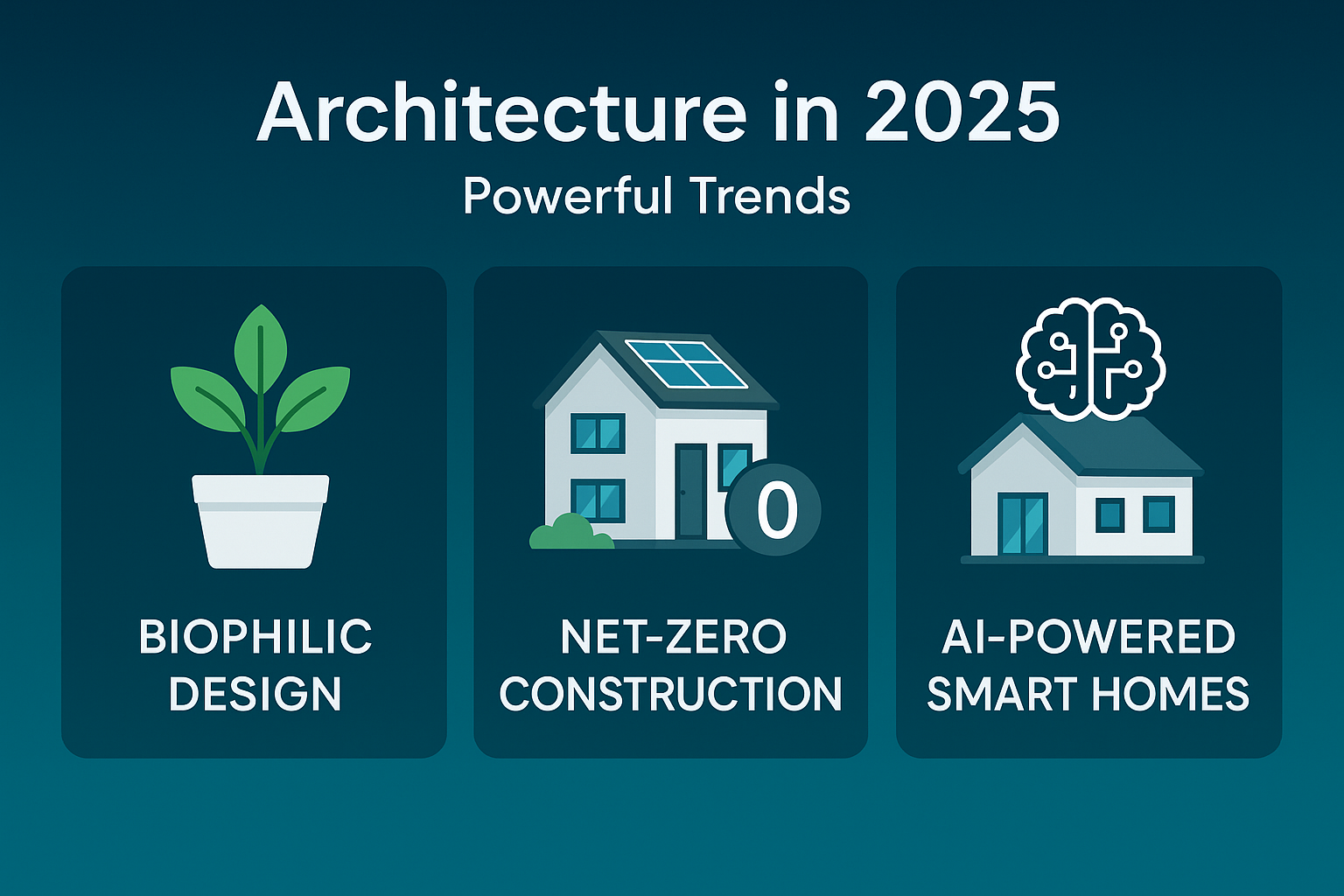
In 2025, architecture is evolving with powerful trends like biophilic design, net-zero construction, and AI-powered smart homes
Cutting Construction Costs with Advanced Materials
We're tapping into the power of cutting-edge materials like engineered timber, aerogel insulation, and self-healing concrete to help slash material costs while boosting durability and energy efficiency. These innovative materials not only promise lower maintenance but also deliver long-term savings for both homeowners and businesses.
Innovative Construction Materials
| Material | Key Features | Applications |
|---|---|---|
| Engineered Timber |
- Layers of wood bonded with adhesives or fasteners. - Types: Cross-Laminated Timber(CLT) (walls, floors) and Glue-Laminated Timber(Glulam) (beams, columns). - Strength comparable to steel and concrete. - Excellent insulator. - Carbon-neutral and renewable. |
Residential buildings, commercial spaces, modular constructions. |
| Aerogel Insulation |
- Made of silica with 90-99% air volume. - Thermal conductivity as low as 0.015 W/m·K. - Non-combustible and water-repellent. - UV-resistant, durable, and space-efficient. |
Wall insulation, pipeline insulation, and space exploration. |
| Self-Healing Concrete |
- Concrete infused with bacteria or encapsulated polymers. - Biological healing via calcium carbonate production. - Seals cracks up to 0.8 mm wide. - Prevents water infiltration and corrosion. - Reduces repair frequency. |
Bridges, tunnels, high-rise buildings, marine structures. |
Faster Project Delivery with Modular Construction
By using prefabricated modules, we make the construction process much smoother, allowing us to finish projects up to 40% faster. This method not only cuts down on the amount of labor needed on-site but also minimizes waste, making it a smart and environmentally friendly option for both residential and commercial builds.
Prefabricated Modules
Prefabricated modules are components of a building that are constructed in a factory and then put together on-site. They help make the construction process smoother, cut down on costs, and boost overall efficiency.
Key Features & Specifications:
Material: Choose from steel, concrete, or engineered timber-based panels.
Design: Fully customizable for walls, floors, ceilings, and entire rooms.
Efficiency: Reduces construction time by up to 40%.
Sustainability: Minimizes waste and supports recycling of materials.
Durability: High resistance to weather and wear, suitable for residential and commercial buildings.
Applications: Modular homes, office spaces, and industrial units.
AI-Driven Lighting Systems
AI-powered lighting systems not only save energy but also boost user comfort through intelligent automation.
Key Features & Specifications:
Technology: Sensors and AI algorithms adjust lighting based on occupancy, daylight, and user preferences.
Energy Savings: Reduces energy consumption by up to 60%
Customization: Personalized lighting profiles for different zones or times of the day.
Integration: Works seamlessly with smart home systems.
Control Options: Mobile apps, voice commands, or automated schedules.
Applications: Smart homes, offices, and public spaces.
AI-Driven Temperature Control Systems
AI-driven temperature systems create a comfortable indoor environment while minimizing energy use.
Key Features & Specifications:
Technology: Uses sensors to monitor temperature, humidity, and air quality in real-time.
Adaptive Learning: Learns user habits to adjust settings automatically.
Energy Efficiency: Reduces HVAC energy use by up to 30%.
Connectivity: Compatible with IoT devices for centralized control.
Applications: Residential, commercial, and industrial buildings.

Comments